Virtual Reality as a tool to map the emotional side of pain
Pain is a combination of (sensory) perception and (emotional) experience. With a Virtual Reality setup, these two can now be distinguished, to evaluate drug effects on the emotional aspect of pain.
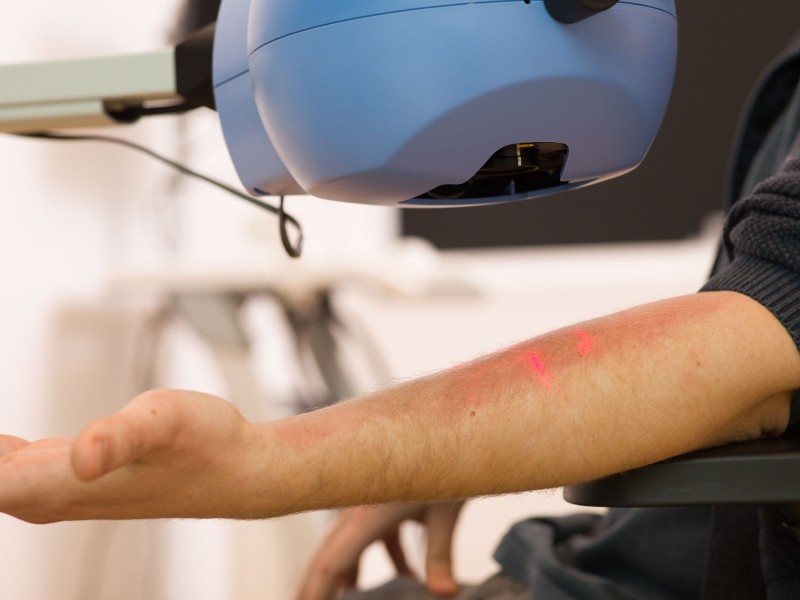
The CHDR PainCart® consists of a number of pain tests. In one of these, pain is induced by applying electrodes to the lower leg and administering an electrical stimulus. The current of the electrical stimulus is gradually increased, and the participant is asked to press a button when pain starts (the pain detection threshold) and when pain is intolerable (the pain tolerance threshold). This test forms the basis for an innovation involving Virtual Reality (VR). The participant is given VR glasses that show an avatar of the lower leg with the electrodes. As the current is increased, the image becomes increasingly disturbing. The skin changes colour as if it were burning, after which smoke emerges and eventually a hissing sound is heard. It will come as no surprise that in this test scenario, the study participant experiences more pain. And this was confirmed in the validation study: with the disturbing VR animation, the point at which participants reached their pain tolerance level was observed at much lower currents than when a neutral avatar of the leg was being shown.
‘Pain perception has a sensory-discriminative side and an emotional side,’ says Dr Marieke Niesters, Research Director Pain. 'Part of your brain is busy with perception: where is the pain? How does it feel? But there is always an emotional side to it as well. If you are afraid, it hurts more, and if you are distracted, for example during a sporting performance, you may not feel the pain at all. That combination always makes pain research complicated. That is why it is great that we now have a method to evaluate the emotional component of pain separately. Because there are drugs that mainly target the sensory side, but also drugs aimed at the emotional aspect of pain.'
The VR pain model developed at CHDR by Senior Clinical Scientist Ingrid Koopmans has now been validated. It was also demonstrated that the effect on pain perception of the burning VR animation is absent when participants receive diazepam, an anxiolytic drug. ‘This corresponds with what we see at the pain clinic. Patients who are anxious often experience more pain. If you treat the anxiety, the pain also decreases,’ says Niesters. ‘We are curious to see what this test will show with novel painkillers, especially those that act on parts of the brain involved in emotional evaluation.’
Interested in learning more?
More articles from Developing methods